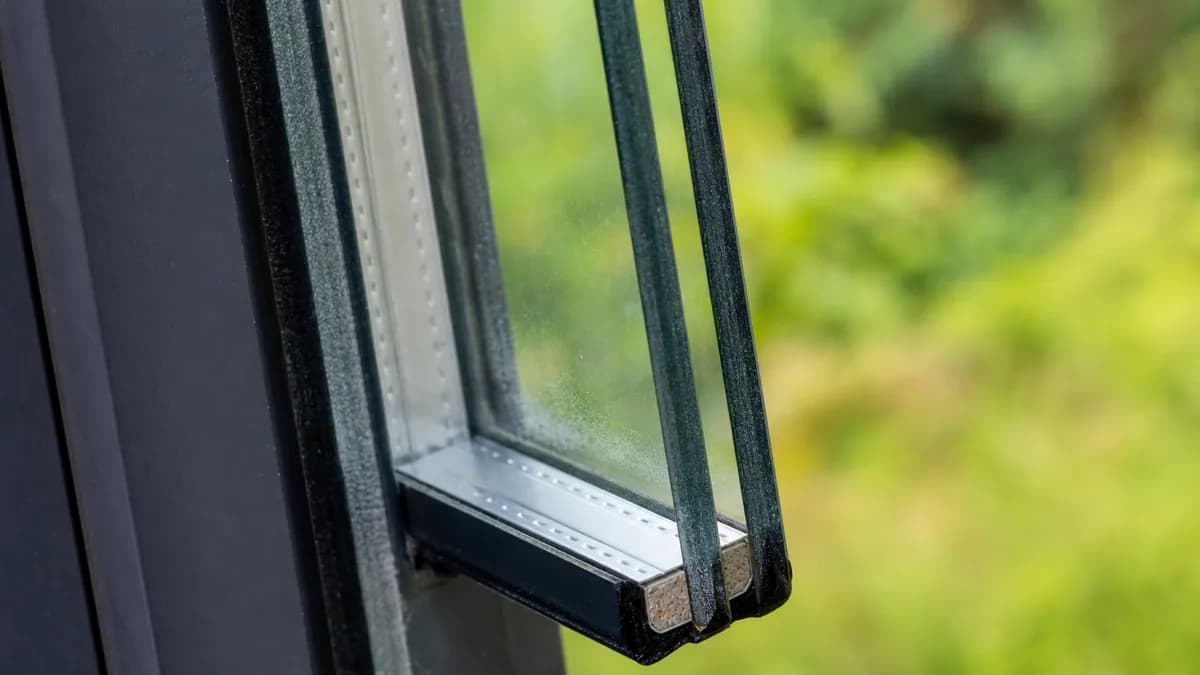
How a double-pane window works
A double-pane (dual-pane) window holds an insulated glass unit, or IGU: two sheets of glass separated by a spacer around the edge and sealed so the gap between them is closed off. The sealed space slows heat flow far better than a single sheet. Many units fill that space with argon gas, and most add a low-e coating on one inner surface to cut solar heat.
- Spacer: the strip around the edge, visible in the photo above. Warm-edge spacers made of less conductive material reduce condensation at the glass edge.
- Desiccant: a drying agent inside the spacer that absorbs moisture trapped during manufacture.
- Seals: a primary and often a secondary seal that keep outside air and moisture from getting in.
Single-pane vs dual-pane in a valley house
| Single-pane | Dual-pane with low-e | |
|---|---|---|
| Summer afternoon sun | Glass gets hot and radiates heat into the room | Coating reflects much of the solar heat |
| Winter mornings | Cold glass, often condensation on the inside | Inner pane stays closer to room temperature |
| Street and freeway noise | Little reduction | Noticeably quieter; laminated glass quieter still |
| 2026 energy code | Cannot meet U 0.27 / SHGC 0.23 | Configurations available that meet it |
A single-pane window cannot be brought to code by swapping its glass for a dual-pane unit if the old frame or sash can't hold the thicker IGU. That is usually the case with older thin aluminum frames, so going from single to dual-pane generally means a full new window. Most of those jobs in stucco homes go in as retrofit windows.
Fogged glass and failed seals
When a seal fails, humid air gets into the space between the panes. The desiccant eventually saturates, and you start to see haze, droplets or a milky film that you can't wipe off from either side. It often comes and goes with the weather at first, then becomes permanent. Sun-exposed windows tend to show it first because they go through the biggest daily temperature swings.
- Condensation on the room side is a humidity issue, not a failed seal. Ventilation usually solves it.
- Condensation on the outside on cool mornings is normal for efficient glass.
- Fog between the panes is a failed seal. If argon was in the unit, much of it has likely escaped.
Some services offer to drill and "defog" a failed unit. That can improve the look, but it does not restore the seal or the gas fill, so ask what it does and does not fix before paying for it.
Glass-only repair or full replacement
Under Title 24, replacing glass in an existing sash and frame, or replacing sashes in an existing frame, is a repair, as long as the replacement is at least equivalent to the original in performance. The new-window U-factor and SHGC limits don't apply to that work.
| Choose glass-only when | Choose a full new window when |
|---|---|
| One or two units have fogged and the frames are sound | Several units are failing at once, especially on the same exposure |
| The window still operates smoothly and seals well | Sashes stick, rollers or balances are worn, or frames are warped |
| The frames match the rest of the house and you want to keep them | The windows are single-pane or the frame can't take a modern IGU |
| Budget is tight and the problem is the glass | You want a code-level upgrade in efficiency and comfort |
Glass replacement is covered in more detail on window glass replacement.
What double-pane work costs
National guide figures, not Sacramento quotes. The glass figures come from a search summary of national cost guides, so treat them as rough.
| Job | Typical national range |
|---|---|
| Replace a double-pane glass panel (IGU) | About $150–$400 per panel |
| Window glass replacement, overall | About $250–$1,000 |
| New window, installed (Fixr average) | About $800; typical $450–$1,200 |
Price by material and style is on window replacement cost in Sacramento.
Choosing a new dual-pane window
For a full replacement in 2026, the window has to meet U-factor 0.27 and SHGC 0.23 in Climate Zones 11 and 12 (U 0.40 / SHGC 0.35 for jobs of 75 sq ft or less). Most dual-pane low-e products are built to hit those numbers; the energy-efficient windows page explains the label. If traffic or rail noise is the main complaint, ask about laminated glass on the noisy side. Triple-pane exists but is rarely necessary in the valley. Make sure the installer holds a C-17 or B license (check at cslb.ca.gov). For the full picture, start with window replacement in Sacramento.
Main guide: window replacement in Sacramento.