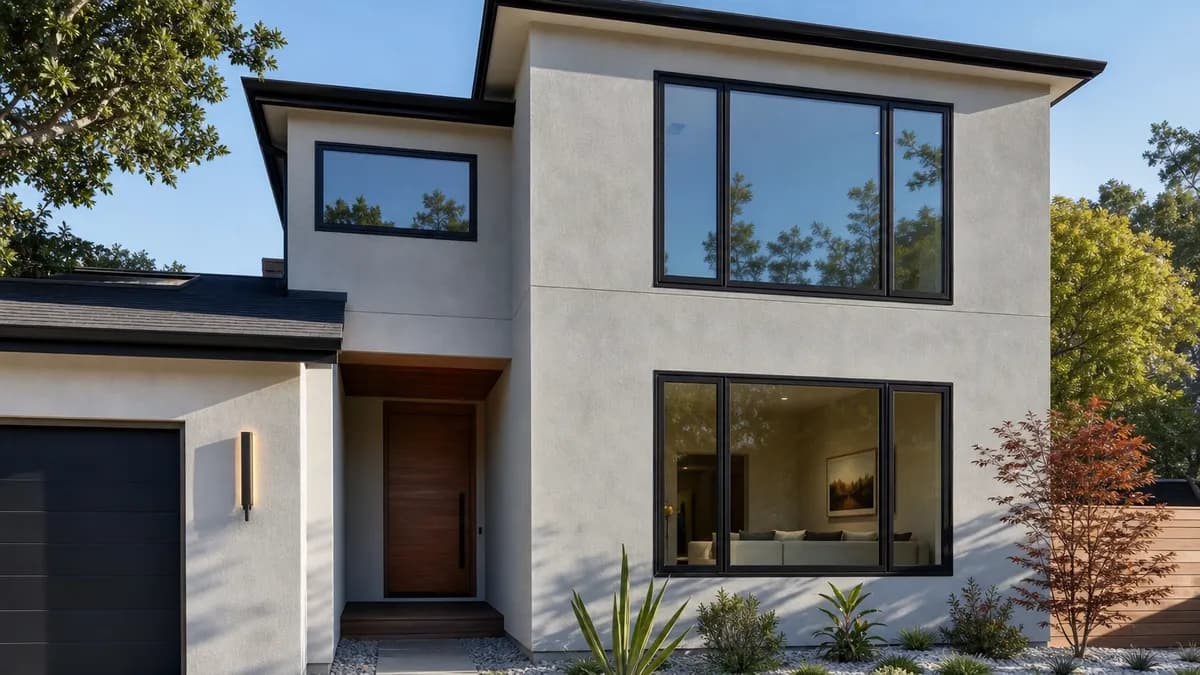
How fiberglass frames are made
Fiberglass frames are pultruded: glass fibers are pulled through a resin bath and a heated die, which produces a rigid, hollow profile. Some lines fill the hollows with foam insulation. The result is a frame that is much stiffer than vinyl, so it can be made narrower for the same glass size and still stay square.
Because the frame is largely glass, it expands and contracts at a rate close to the glass it holds. That keeps seals and corners under less stress through daily temperature swings, which is the main technical argument for fiberglass in a hot inland climate.
Why fiberglass fits hot afternoon sun
Sacramento's summer average high is about 92°F, and heat waves arrive on dry north winds before the delta breeze returns in a few days. A west-facing window takes the worst of it from mid-afternoon to sunset. Fiberglass shrugs off that heat cycle with less movement than vinyl, and its factory finish is built to hold color in strong sun.
Black fiberglass windows
Black frames are the clearest case for fiberglass. A dark frame on a stucco wall can get very hot, and fiberglass tolerates that better than standard vinyl. If the look on the house in the photo above is what you want, fiberglass is usually the first material an installer will suggest. Ask whether the color is a factory finish and how the manufacturer's warranty treats it.
Paintable frames
Many fiberglass frames can be painted later if you change the house color, which vinyl generally does not allow. Confirm with the specific product line before you count on it.
Fiberglass window cost
National cost-guide ranges, per window installed. We found no Sacramento-specific source, so use these to sanity-check quotes rather than to predict one.
| Source | Fiberglass | Vinyl, for comparison |
|---|---|---|
| Fixr | $400–$1,500 | $350–$800 |
| HomeGuide / Angi (search summary) | $400–$2,000 | $200–$1,500 |
| Pella by-material page | $1,100–$2,200+ | $800–$1,600 |
On a whole-house job the gap between vinyl and fiberglass adds up fast, so many homeowners mix them: fiberglass on the street side or the hot west wall, vinyl elsewhere. See window replacement cost in Sacramento for how size and style move the number.
Energy code values still apply
A stronger frame does not change the 2026 rules. Under the 2025 Title 24 code, replacement windows in Climate Zones 11 and 12 need a U-factor of 0.27 or lower and an SHGC of 0.23 or lower, unless the job is 75 sq ft or less, where U 0.40 and SHGC 0.35 are allowed. Low SHGC glass matters most on west and south exposures. Details are on the energy-efficient windows page.
Fiberglass lines you will hear about
We are not a dealer, affiliate or authorized installer for any brand, and an installer in our network may or may not carry a particular line.
- Milgard Ultra is Milgard's fiberglass series. See Milgard windows.
- Pella Impervia is Pella's fiberglass line. See Pella windows.
- Andersen Fibrex (100 Series) is a composite, not fiberglass. Andersen positions it as more affordable than fiberglass.
Fiberglass vs vinyl: a quick comparison
| Factor | Fiberglass | Vinyl |
|---|---|---|
| Frame width | Slimmer for the same glass | Wider to carry the same glass |
| Dark colors in strong sun | Handles them well | Needs a special dark-color build |
| Repainting later | Often possible | Generally not |
| Price (Fixr, per window) | $400–$1,500 | $350–$800 |
If budget is the deciding factor and white frames are fine, vinyl windows usually win. If you want the warmth of real wood inside, look at wood windows, some of which have a clad exterior. For the full process, start with window replacement in Sacramento.
Main guide: window replacement in Sacramento.